

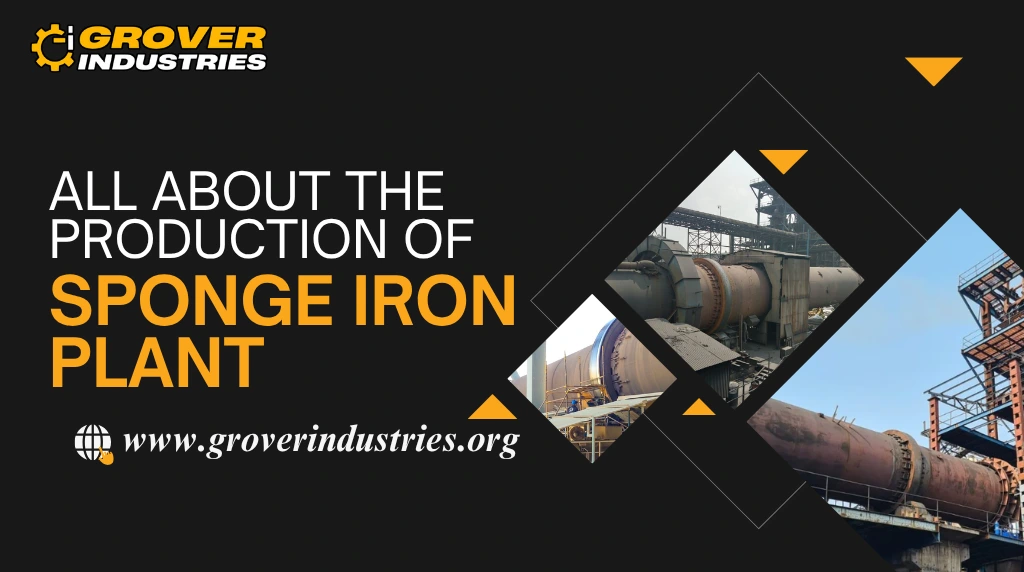
All about the Production of Sponge Iron Plant
In the heart of Uttar Pradesh, Grover Industries has established itself as a leading player among Sponge Iron Plant Manufacturers in Ghaziabad Uttar Pradesh and more broadly among Sponge Iron Plant Manufacturers in India. This blog dives deeply into how a sponge iron (or direct reduced iron, DRI) plant works, the steps Grover Industries follows, and the strategic advantages and challenges in this sector.
What is Sponge Iron (DRI) and Why it Matters:
Sponge iron, also known as direct reduced iron (DRI), is metallic iron produced by removing oxygen from iron ore in the solid state (i.e. without melting) using reducing agents such as carbon monoxide, hydrogen, or directly carbonaceous materials.
In India, the most common route is coal-based rotary kiln reduction, owing to abundant domestic coal reserves and relatively limited access to low-cost natural gas.
Sponge iron is heavily used as a substitute for scrap in induction furnaces and electric arc furnaces in secondary steelmaking, because scrap is often expensive, inconsistent, or in short supply.
By positioning itself as a dependable supplier, Grover Industries helps steel mills maintain consistent quality while diversifying raw material sources.
The Sponge Iron Production Process at Grover Industries:
Below is a generalized overview of the process flow, adapted to how Grover Industries may implement it (drawing from industry best practices):
1. Raw Material Preparation:
- Iron ore/iron ore lumps/pellets: High-grade hematite or magnetite ore is selected. The ore may be screened to appropriate size (e.g. 5–20 mm) and cleaned.
- Non-coking coal/carbonaceous reductant: This acts as the fuel and reducing agent. Quality parameters such as volatile content, fixed carbon, ash, and moisture are critical.
- Flux/additives: Limestone, dolomite, or other fluxes may be added to control gangue composition or help in slag formation if needed.
All raw materials must meet strict specifications so that the metallization and final sponge quality are optimal.
2. Feeding and Mixing:
Grover Industries ensures precise weighing and blending of ore, coal, and flux in stipulated ratios. The blend is then preheated or homogeneously mixed before charging into the kiln.
3. Reduction in Rotary Kiln (or Shaft / Hybrid Setup):
- In our region and for many Indian plants, a rotary kiln is the standard choice. The kiln is slightly inclined and rotates slowly.
- The material moves from the feed end toward the discharge end while being heated progressively.
- Typical temperatures range from 800 °C to around 1,100–1,200 °C in various zones.
- The gas and solid phases move in counterflow, enabling gradual heating and reduction.
In some advanced setups, Grover Industries might adopt hybrid routes or gas injection to enhance efficiency and reduce emissions (though the default is coal-based in most Indian units).
4. Cooling & Discharge:
Once reduced, the hot sponge iron is passed through a rotary cooler (indirect or water-cooled) to bring it to safe handling temperatures.
During cooling, residual heat is often recovered or used for preheating incoming material or generating steam, which Grover Industries may exploit to improve energy efficiency.
5. Magnetic Separation & Screening:
After cooling, the sponge iron product may still contain entrained coal char or unreacted carbon. Grover Industries uses magnetic separation and screening to separate metallic sponge from unwanted fines or byproducts.
Screening also classifies the product by size grades, suitable for different furnace or customer requirements.
6. Handling, Storage & Dispatch:
- Proper handling is crucial because sponge iron is pyrophoric (i.e., it can oxidize or even self-ignite when moist).
- Grover Industries stores sponge iron under cover, protects it from moisture, and ensures proper sealing during transport.
- Packaging may include bulk loading, bagging in HDPE bags, or special containers depending on customer needs.
Key Technical & Operational Considerations for Grover Industries:
As a prominent Sponge Iron Plant Manufacturer in Ghaziabad Uttar Pradesh, Grover Industries must manage multiple technical and strategic factors:
- Raw material availability and cost: Access to good quality iron ore and competitive coal is critical. Since India relies heavily on coal-based DRI, fluctuations in coal quality or transportation costs directly impact production economics.
- Energy efficiency and heat recovery: Efficient waste‐heat recovery, kiln insulation, and process integration help reduce fuel consumption per ton of sponge iron.
- Emission controls and environmental compliance: Sponge iron plants are classified as “Red Category” owing to their pollution potential. Grover Industries must maintain dust control (bag filters, electrostatic precipitators), gas scrubbing, and effluent treatment systems.
- Process stability and metallization: Controlling the degree of metallization (i.e. fraction of iron in metallic form), minimizing FeO content, and controlling impurities (S, P) are vital for high performance.
- Scalability and modular design: Grover Industries may design their plants in modular fashion so that capacity can be scaled with additional kiln trains or reactors.
- Sustainability and decarbonization trends: Global and Indian steel policies now push for reduced carbon footprints. Grover Industries would benefit by exploring hydrogen injection, biomass co-firing, or switching to low-carbon reductants eventually.
- Quality assurance and customer satisfaction: Delivering a consistent sponge iron grade, meeting chemical specifications, and ensuring safe transport are essential to retain trust among steel mills.
The Role & Positioning of Grover Industries:
- As a Sponge Iron Plant Manufacturer in Ghaziabad Uttar Pradesh, Grover Industries is uniquely located in a region with access to North Indian markets and good logistic linkages.
- By combining modern engineering, careful raw material sourcing, and environmental safeguards, Grover Industries can claim to provide turnkey solutions to steel and foundry customers.
- Among Sponge Iron Plant Manufacturers in India, Grover Industries distinguishes itself by focusing on flexibility, modular expansion, and compliance with evolving environmental norms.
- The company can also offer consultancy or retrofit services to existing DRI plants, optimizing performance or integrating emission control systems.
Challenges & Future Outlook:
While the sponge iron industry holds promise, Grover Industries must navigate:
- Raw material volatility: Fluctuations in iron ore exports or domestic policies (e.g. export duties) can squeeze margins.
- Regulatory and environmental pressures: Stricter norms may require retrofitting, investing in cleaner technologies, or carbon capture.
- Competition from gas-based DRI: Although coal-based DRI dominates in India, gas-based and hydrogen-assisted reduction processes are rising globally.
- Energy costs and carbon tax risks: As carbon accounting becomes mainstream, cost of emissions or carbon credits may affect operations.
However, given India’s steel demand, infrastructure drive, and push toward self-reliance, the future of sponge iron remains strong. Grover Industries can capitalize by being agile, environmentally compliant, and technology-driven.
Conclusion:
Grover Industries commitment as a premier Sponge Iron Plant Manufacturer in Ghaziabad, Uttar Pradesh and among Sponge Iron Plant Manufacturers in India is to deliver high-quality, efficient, and environmentally responsible DRI plants for India’s booming steel sector. If you’d like a customized proposal or deeper technical white paper, I’d be happy to help refine further.
FAQs:
1. What capacity can Grover Industries build for a sponge iron plant?
Grover Industries can design modular plants varying from small (e.g., 100 TPD) to large multi-train setups (e.g. several hundred thousand tons per year), depending on client requirement and site constraints.
2. Which reduction technology does Grover Industries use?
Primarily coal-based rotary kiln design is used due to cost and local suitability. However, Grover can adopt hybrid or gas injection options if clients demand lower emissions.
3. How does Grover manage emissions and pollution control?
We integrate dust collection (bag filters, ESP), gas scrubbers, cyclones, and effluent treatment to ensure compliance with local environmental norms.
4. What is metallization, and how does Grover ensure high metallization?
Metallization is the percentage of iron in metallic (reduced) form. Grover optimizes kiln temperature zones, residence time, and carbon/oxygen balance to achieve high metallization (typically above 85–90 %).
5. How is sponge iron transported safely?
We package sponge iron under cover, ensure dryness, use sealed containers or HDPE bags, and avoid exposure to moisture or air which could cause oxidation or self-heating.
6. Can Grover retrofit existing DRI plants?
Yes — Grover offers engineering upgrades, energy efficiency retrofits, emission control additions, and performance enhancement services.
7. What is the expected fuel consumption per ton of sponge iron?
It depends on design and raw material quality, but efficient plants often aim for lower coal consumption (~600–700 kg COAL per ton of DRI or better) plus associated power and utilities.
8. What is the lifecycle and maintenance schedule for the plant?
Critical components like kiln shells, refractory lining, cooler internals, instrumentation require scheduled maintenance every few years. Grover provides maintenance planning and spare part support.