

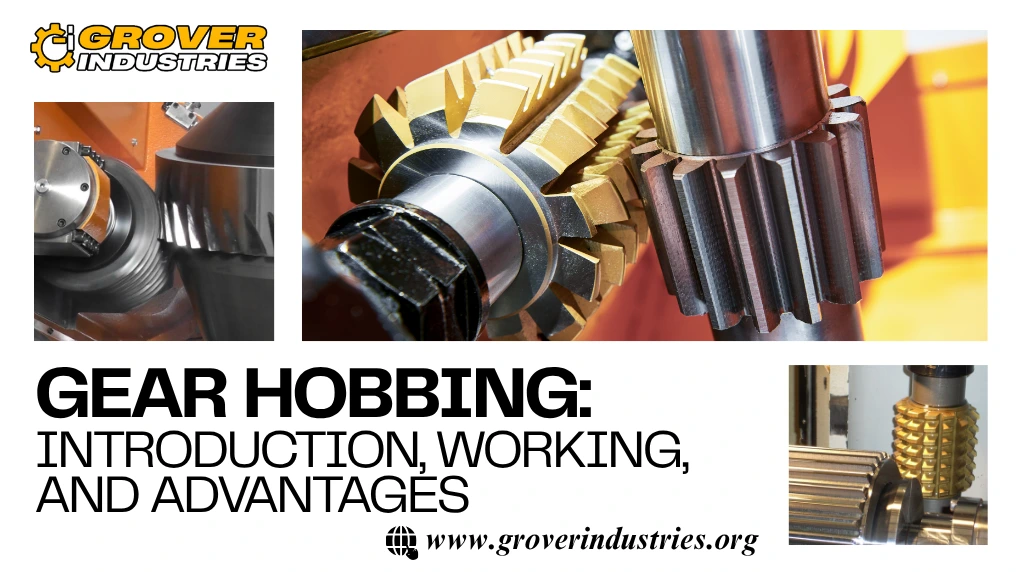
Gear Hobbing: Introduction, Working, and Advantages
In today’s high-precision manufacturing environment, the demand for accurately cut gears is higher than ever. At Grover Industries, one of the leading Hobbing Cut Gear Manufacturers in Ghaziabad Uttar Pradesh and among the foremost Hobbing Cut Gear Manufacturers in India, we specialise in delivering gears that meet rigorous standards of geometry, finish and reliability. In this blog, we’ll walk you through what gear hobbing is, how the process works, and what business-benefits it offers — all through the lens of our capabilities at Grover Industries.
What is Gear Hobbing?:
Gear hobbing is a highly efficient, versatile cutting process used to manufacture a wide range of gears, splines and sprockets. Essentially, it involves a rotating workpiece (the gear blank) and a rotating cutting tool called a hob which mesh together in a coordinated motion to cut gear teeth.
At Grover Industries, as one of the top Hobbing Cut Gear Manufacturers in Ghaziabad Uttar Pradesh, we employ state-of-the-art CNC gear hobbing machines to ensure that gear tooth geometry is accurately formed. The continuous nature of the hobbing process allows for high productivity and consistent quality, supporting our mission to serve domestic and export markets across India.
How Does the Gear Hobbing Process Work?:
Here’s a breakdown of the key steps in the gear-hobbing process as carried out at Grover Industries:
- Preparation of the gear blank: A correctly sized gear blank is mounted on the hobbing machine arbor. The blank’s axis must be aligned and secured for the process.
- Selection and installation of the hob cutter: The hob (a cutting tool resembling a worm gear with multiple flutes) is selected based on gear type (spur, helical, worm, spline) and installed.
- Synchronization and feed setting: The gear blank and the hob are set to rotate in a precise ratio so that each hob flute cuts a tooth flank with every revolution of the gear blank. At Grover Industries, our skilled operators programme the machine’s feed, depth of cut and spindle speeds to achieve the required profile accuracy.
- Cutting action: As the hob rotates, the gear blank is fed gradually until the desired tooth depth is achieved. The hob and blank maintain a relative motion that generates the involute tooth profile. For helical gears, the hob angle and blank feed are synchronised to form the helix.
- Multiple blanks or gang-cutting (optional): Depending on batch size, multiple gear blanks may be mounted on the arbor and hobbing can be executed simultaneously to boost throughput.
- Post-process operations: After hobbing, gears may be deburred, heat treated, ground or surface finished to meet tolerances or application requirements. At Grover Industries, although hobbing often enables near-final tolerance, we have in-house finishing to deliver ready-to-install components.
By adopting this process, we as Hobbing Cut Gear Manufacturers in India are able to deliver quality gears for automotive, agricultural, industrial transmission, machine tool and heavy-engineering applications.
Why Choose Gear Hobbing and What are the Advantages?:
The gear hobbing method offers several compelling advantages — and at Grover Industries we harness these benefits to deliver superior value to our customers:
- Speed and Productivity: Unlike many other gear-cutting methods that may require multiple tool changes or intermittent cutting, gear hobbing operates in a continuous mode. This means faster cycle times and increased throughput for both small and large batches.
- Accuracy and Consistency: The synchronised motion between blank and hob enables precise tooth geometry with minimal variation. At Grover Industries our CNC-hobbing machines and tooling setups ensure repeatability and the tight tolerances required by modern industrial gear sets.
- Versatility of Gear Types: Hobbing is capable of producing a wide range of gear types — spur gears, helical gears, splines, worm gears, sprockets and more. This flexibility makes Grover Industries a one-stop-shop among Hobbing Cut Gear Manufacturers in Ghaziabad Uttar Pradesh for diverse applications.
- Economical for Batch Production: Because of the efficiency and reduced tool-change downtime, gear hobbing is economically favourable especially when compared to older forms of gear production. The capability to handle both high-volume runs and small batches gives our clients cost-effective solutions.
- Strong Surface Finish and Gear Quality: Modern hobbing setups, when combined with proper tooling and machine alignment (all maintained by our team at Grover Industries), can produce gear teeth with excellent surface finish and minimal post-machining required.
- Scalability and Adaptability: For industries where gear specifications may evolve (for example, varying tooth counts, module or helix angle), hobbing offers flexibility. We at Grover Industries can quickly adapt our setup to new gear forms, supporting our role among leading Hobbing Cut Gear Manufacturers in India.
Applications & Use-Cases (Within Our Manufacturing Scope):
At Grover Industries we deliver hobbing-produced gears for sectors such as:
- Transmission gears for agricultural and earth-moving equipment
- Helical and spur gears for industrial drives and gearboxes
- Splines and shafts for machine-tool applications
- Sprockets and worm gears for material-handling systems
Because gear hobbing supports all of these gear types efficiently, it underpins our ability to serve domestic and export clients with high-quality gear solutions.
Why Partner with Grover Industries?:
Choosing the right manufacturing partner is critical. Here’s why Grover Industries stands out among Hobbing Cut Gear Manufacturers in Ghaziabad Uttar Pradesh and across India:
- Fully-equipped CNC gear hobbing machines operated by experienced technicians who understand gear geometry, inspection and finishing.
- End-to-end capability: from blank preparation through hobbing to finishing, inspection and dispatch – ensuring shorter lead times and streamlined quality control.
- Flexibility to handle custom gear requirements, variable batches (small to large) and exacting gear specifications.
- Commitment to quality and precision: we employ metrology equipment, gear-inspection tools and stringent process controls to deliver gears that meet or exceed specifications.
- Geographical advantage: being based in Ghaziabad (Uttar Pradesh), we are well-placed to serve clients across northern India and beyond, offering efficient logistics and support.
Conclusion:
In the competitive landscape of gear manufacturing, the hobbing process remains a cornerstone technique — offering speed, precision, versatility and cost-effectiveness. At Grover Industries, as one of the premier Hobbing Cut Gear Manufacturers in Ghaziabad Uttar Pradesh and recognised among Hobbing Cut Gear Manufacturers in India, we leverage this method to deliver dependable, high-quality gear solutions that meet the demanding needs of today’s industries. Whether you need spur gears, helical gears, splines or custom transmission solutions, we invite you to partner with us for manufacturing excellence.
FAQs:
1. What types of gears can be produced using gear hobbing?
Gear hobbing can manufacture a wide variety of gears including spur gears, helical gears, worm gears, splines and sprockets. The process is highly adaptable to different gear profiles, diameters and tooth counts.
2. How does gear hobbing compare with other gear-cutting methods?
Compared with methods like gear shaping or gear milling, hobbing offers faster cycle times, fewer tool changes and greater consistency in large volume production. Its continuous cutting action also contributes to better productivity.
3. Is gear hobbing suitable for small batch production?
Yes — although gear hobbing excels in high-volume production, modern CNC hobbing machines (like those at Grover Industries) make it feasible and economical for small and medium batch sizes as well, provided setups are optimised.
4. What are the key factors that affect gear quality in hobbing?
Critical factors include correct hob selection, accurate synchronization of hob and blank rotation, feed and depth settings, machine alignment, gearbox stability and proper tooling maintenance. Inspection and finishing also play a role.
5. Can special or customised gear profiles be produced with hobbing?
Absolutely. Gear hobbing can handle customised modules, tooth counts, helix angles and splines. At Grover Industries we work with customers to engineer gears to custom specifications, offering full support from design through production.
6. What is the typical lead time for gear production using hobbing?
Lead time depends on batch size, gear complexity, finishing requirements and client specifications. With streamlined operations and in-house capabilities, Grover Industries strives to offer competitive lead times while maintaining quality.
7. Are there limitations to gear hobbing?
While highly versatile, hobbing may require change-over for radically different gear sizes or profiles, and very small gear sizes or extremely large diameters may require specialised setups or alternate methods. However, modern equipment covers a broad range.
8. Why should a company choose Grover Industries for hobbing-based gear manufacturing?
Because Grover Industries offers experienced engineering, high-precision CNC hobbing machines, full finishing and inspection capabilities and a strategic location in Ghaziabad — all contributing to dependable quality, shorter lead-times and cost-effective production for clients across India and beyond.