

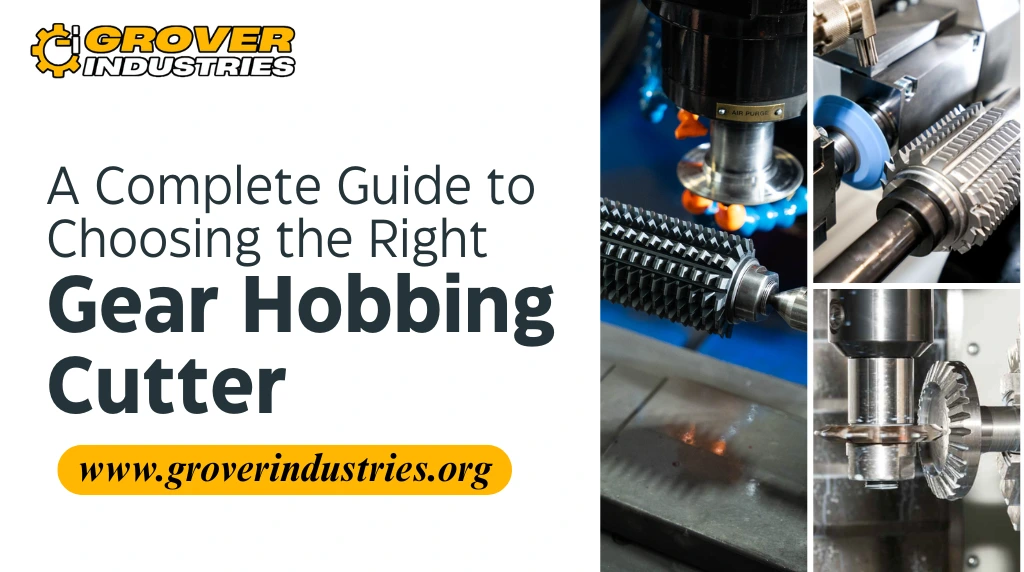
A Complete Guide to Choosing the Right Gear Hobbing Cutter
Selecting the right gear hobbing cutter is crucial for producing high-quality gears that meet strict precision, durability, and performance requirements. Whether you’re manufacturing automotive transmissions, industrial machinery, or precision instruments, the gear hobbing cutter you choose directly influences productivity, tool life, surface finish, and overall production cost. As a trusted Hobbing Cut Gear Manufacturer and Supplier in Ghaziabad Uttar Pradesh India, Grover Industries brings you this comprehensive guide to help you make an informed decision when choosing a gear hobbing cutter.
What is a Gear Hobbing Cutter?:
A gear hobbing cutter—or gear hob—is a cylindrical cutting tool used in the gear hobbing process to generate teeth on gears by progressive cutting. Mounted on a hobbing machine, it rotates while feeding into a gear blank to form precise and accurate gear teeth. Gear hobbing is widely used for producing spur gears, helical gears, splines, sprockets, and other toothed parts with high repeatability and efficiency.
Key Factors in Choosing the Right Gear Hobbing Cutter:
Choosing the best gear hobbing cutter involves evaluating the combination of gear design requirements, cutter specifications, material compatibility, accuracy needs, and machine capabilities. Below are the main factors to consider:
1. Understand Your Gear Specifications:
Before selecting a cutter, you must define the gear’s essential design parameters:
- Module or Diametral Pitch: Matches the size of the gear teeth.
- Number of Teeth: Determines hob start configuration.
- Pressure Angle: Commonly 14.5°, 20°, or 25°. Mismatched angles lead to functional issues.
- Helix Angle (for Helical Gears): Must align with cutter design.
Accurate understanding of these parameters ensures the gear hob you select will produce components that mesh correctly and perform reliably in application.
2. Cutter Material and Coating:
The material of the gear hob cutter impacts tool life, cutting speed, and overall quality:
- High-Speed Steel (HSS): Offers toughness and re-sharpenability; ideal for general-purpose and low-volume production.
- Carbide and Carbide-Tipped Hobs: Provide superior wear resistance and maintain sharp cutting edges at high speeds, suited for hardened materials or high-volume gear production.
- Coatings: Titanium Nitride (TiN), Titanium Carbonitride (TiCN), and Aluminum Chromium Nitride (AlCrN) coatings reduce friction and heat, extending tool life, especially in abrasive or high-speed applications.
Selecting the right material and surface treatment can dramatically improve efficiency, reduce downtime, and lower long-term tooling costs.
3. Accuracy and Precision Standards:
Gear hobbing cutters are manufactured to different accuracy classes (e.g., DIN or ISO standards). Higher accuracy hobs are necessary for precision applications:
- Class AAA / AA: Premium accuracy for high-precision gears.
- Class A / B / C: Suitable for general industrial applications at varying levels of precision.
Choosing a cutter with an accuracy class matching your gear quality requirement ensures the final product meets performance expectations with minimal post-processing.
4. Number of Starts and Profile Type:
Gear hobbing cutters can be single-start or multi-start:
- Single-Start Hobs: Ideal for general applications requiring high precision.
- Multi-Start Hobs: Increase productivity by cutting multiple tooth spaces simultaneously, suited for coarse modules and large volume production.
Profile type also matters; standard involute profiles cover most gears, while special profiles address unique tooth geometries or custom designs.
5. Machine Compatibility and Mounting Style:
Ensure that the cutter you select is compatible with your hobbing machine’s spindle, speed, and power ratings:
- Shank Type: Must fit the machine arbor or holder securely.
- Diameter and Length: Should align with machine capacity and the size of gears to be produced.
Clarifying these details upfront avoids costly tool mismatches and production delays.
6. Cost-Effectiveness and Supplier Support:
While tooling price matters, total cost of ownership (TCO) is more important. Consider:
- Tool life and wear resistance.
- Availability of re-sharpening and maintenance services.
- Supplier expertise, documentation, and technical support.
As a prominent Hobbing Gear Cutter Manufacturer and Supplier in Uttar Pradesh India, Grover Industries provides high-performance hobs backed by manufacturing experience, technical support, and a focus on quality assurance.
Why Choose Grover Industries for Your Gear Hobbing Needs:
At Grover Industries, we specialize in manufacturing precision gear hobbing cutters tailored to varied industrial needs. Our cutters are engineered to:
- Provide excellent tooth accuracy and surface finish.
- Withstand rigorous production environments.
- Deliver consistent performance across a wide range of materials.
- Fit seamlessly with modern hobbing machinery.
Whether your production requires standard modules or custom hob profiles, Grover Industries has the expertise and manufacturing capability to deliver top-tier gear hobbing solutions in Ghaziabad, Uttar Pradesh, India.
Tips for Long-Term Gear Hob Selection Success:
- Review Engineering Drawings Carefully: Match cutter specs to gear design requirements.
- Consult Technical Experts: Supplier advice can help optimize choices for complex applications.
- Plan for Maintenance: Regular inspection and timely re-sharpening extend tool life.
- Invest in Quality Tools: Cutting corners on quality often leads to higher production costs in the long run.
Conclusion:
Choosing the right gear hobbing cutter is not just about matching numbers—it’s about understanding the interplay between gear design, cutter capabilities, and production goals. When quality, precision, and reliability matter, Grover Industries stands as your trusted partner in gear manufacturing excellence.
FAQs:
1. What is a gear hobbing cutter?
A gear hobbing cutter is a cylindrical cutting tool used to generate gear teeth on blanks by synchronized rotation within a gear hobbing machine.
2. How do I know which hob profile to choose?
Select based on your gear’s design specifications, including module, pressure angle, helix angle, and intended application.
3. What materials are gear hobs made from?
Gear hobs are typically made from high-speed steel (HSS), carbide, or carbide-tipped steel, often with specialized coatings to improve performance.
4. Why is accuracy class important?
Accuracy class determines the precision of the cutter, affecting gear quality and meshing performance, especially in precision or high-load applications.
5. Can I use the same cutter for different gear types?
Yes, but optimal performance often requires selecting hobs tailored to the specific gear type (spur, helical, splines).
6. How often should I re-sharpen gear hobs?
Re-sharpening frequency depends on usage levels, material hardness, and cutting conditions; regular inspection helps decide optimal intervals.