

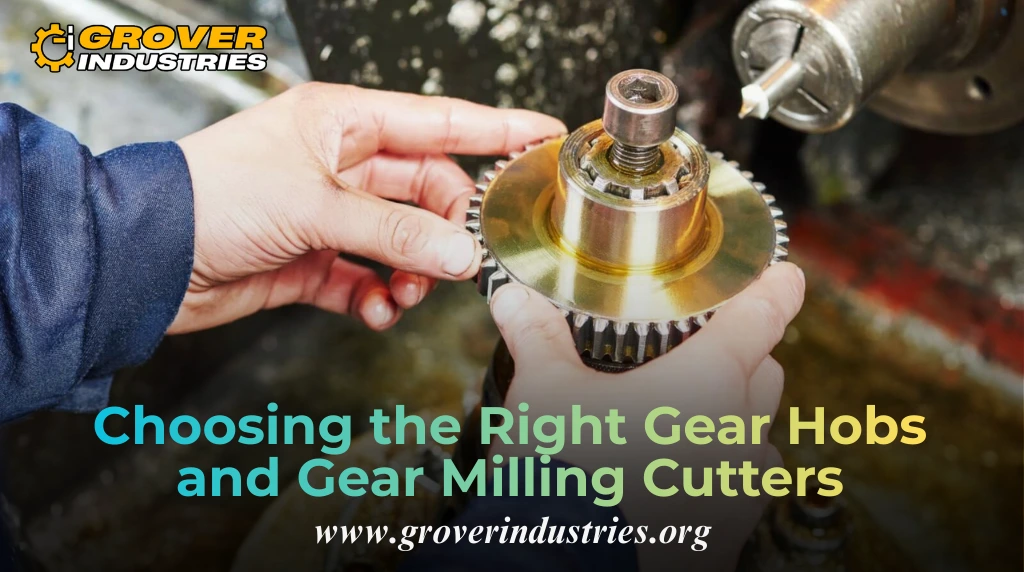
Choosing the Right Gear Hobs and Gear Milling Cutters
In the world of precision engineering and industrial manufacturing, gears are the unsung heroes that keep machines running smoothly. From heavy-duty gearboxes and rolling mills to complex power transmission systems, every high-performance mechanical setup depends on accurately cut and precisely engineered gears. That’s where Grover Industries, a leading Hobbing Gear Cutter Manufacturer and Supplier in Ghaziabad Uttar Pradesh India, stands out — offering world-class gear hobs and gear milling cutters engineered to meet diverse industrial needs.
In this comprehensive guide, we’ll explore what gear hobs and gear milling cutters are, the key differences between them, when to choose which tool, and how Grover Industries’ expertise makes the difference for businesses seeking reliable gear production solutions.
What are Gear Hobs?:
Gear hobs are specialized cutting tools used in the gear hobbing process, a highly efficient and continuous gear cutting method used widely in industrial gear manufacturing. In gear hobbing, a hob — a helical, worm-like cutter — rotates in synchronization with a gear blank (the uncut gear) so that the teeth are generated progressively and precisely as the tool feeds along the workpiece. This generates accurate and consistent gear profiles.
Why Gear Hobbing Is Essential:
- It allows for simultaneous cutting of multiple gear teeth, making it much faster than many alternative methods.
- The continuous and synchronized motion ensures precise tooth profiles, which is crucial for high-volume and high-accuracy gear production.
- Gear hobbing is versatile, producing spur gears, helical gears, worm gears, and splines — making it suitable for a wide range of industrial applications.
At Grover Industries, our gear hobs are crafted with advanced CNC technology and precision engineering, ensuring that industrial gears perform flawlessly in demanding environments. With our expertise as a top Hobbing Gear Cutter Manufacturer and Supplier in Uttar Pradesh India, we support clients across sectors like cement, mining, power, and sugar production with tools built for performance.
What are Gear Milling Cutters?:
Gear milling cutters are tools used in gear milling, a process where gear teeth are cut one at a time. Unlike hobbing, gear milling involves cutting individual teeth in an indexed sequence — meaning the cutter engages, retracts, and repeats for every tooth on the gear blank.
Gear milling is generally slower than hobbing because each tooth requires a separate engagement and repositioning, but it offers advantages for certain applications:
- It’s ideal for low-volume production, prototypes, or when specialized gear profiles are needed.
- Gear milling cutters can be adapted to handle unique or non-standard teeth designs when flexibility is required.
Grover Industries produces precision gear milling cutters that meet stringent quality standards, making them suitable for both general manufacturing tasks and specialized jobs where flexibility and adaptability are essential.
Gear Hobbing vs. Gear Milling: Key Differences:
Understanding when to use gear hobs versus gear milling cutters can help manufacturers optimize efficiency, quality, and cost. Here are the core differences:
Process:
- Gear Hobs: Continuous synchronized cutting
- Gear Milling Cutters: Indexed tooth-by-tooth cutting
Speed:
- Gear Hobs: High — ideal for large production runs
- Gear Milling Cutters: Slower — suitable for low volumes
Precision:
- Gear Hobs: Excellent for repetitive accuracy
- Gear Milling Cutters: Good for customized or prototype gears
Best for:
- Gear Hobs: Mass production of standard gears
- Gear Milling Cutters: Custom or small-batch gear projects
If you’re producing identical gears in high volumes — for example, transmission gears or power train components — gear hobbing with a high-quality hob cutter is often the most efficient choice. Conversely, gear milling may be preferred for experimental designs, small gear blanks, or unique gear shapes that require customized tooling.
Why Quality Gear Cutting Tools Matter:
Whether you’re using gear hobs or gear milling cutters, tool quality directly affects gear performance. High-precision tools ensure accurate tooth geometry, better meshing, lower friction, and longer gear life. Investing in superior tools also:
- Reduces downtime and tool changes, lowering overall production costs.
- Ensures consistent performance across batches, critical for industrial reliability.
- Helps you meet strict engineering standards needed in high-stress applications.
At Grover Industries, we design, manufacture, and supply gear hobs and gear milling cutters that meet rigorous quality benchmarks. With state-of-the-art manufacturing facilities in Ghaziabad and experienced engineers, we deliver tools that industrial clients trust for both production and precision.
Conclusion:
As a renowned Hobbing Gear Cutter Manufacturer and Supplier in Ghaziabad Uttar Pradesh India and across Uttar Pradesh, Grover Industries is committed to excellence, innovation, and reliability. Our broad portfolio of gear cutting tools — combined with customization, quality control, and timely delivery — ensures your manufacturing processes stay ahead of the curve.
Our team works closely with clients to determine the best solution for every unique challenge — whether it’s a high-volume hobbing requirement or a specialized milling setup. With Grover Industries, you gain a partner who understands both the technical and practical aspects of modern gear production.
FAQs:
1. What is the main difference between gear hobs and gear milling cutters?
Gear hobs are used in continuous, synchronized gear hobbing for fast, high-volume production, while gear milling cutters operate with indexed, tooth-by-tooth cutting suitable for custom or low-volume work.
2. Which gear cutting method is more efficient for large batches?
Gear hobbing is generally more efficient for large or repetitive production runs due to its continuous cutting nature.
3. Can gear milling cutters be used on CNC machines?
Yes — gear milling cutters can be used on CNC milling machines for precise and flexible gear cutting tasks.
4. Are gear hobs suitable for all gear types?
Gear hobs are versatile but are especially effective for external gears like spur and helical gears; internal gear cutting may require alternative methods.
5. Why is precision important in gear cutting tools?
Precision ensures gears mesh smoothly, operate quietly, and last longer without failure — all critical for industrial machinery performance.
6. How does Grover Industries support custom gear cutting needs?
Grover Industries offers customized tooling solutions, tailored technical support, and high-quality gear hobs and milling cutters designed for specific applications and industries.