

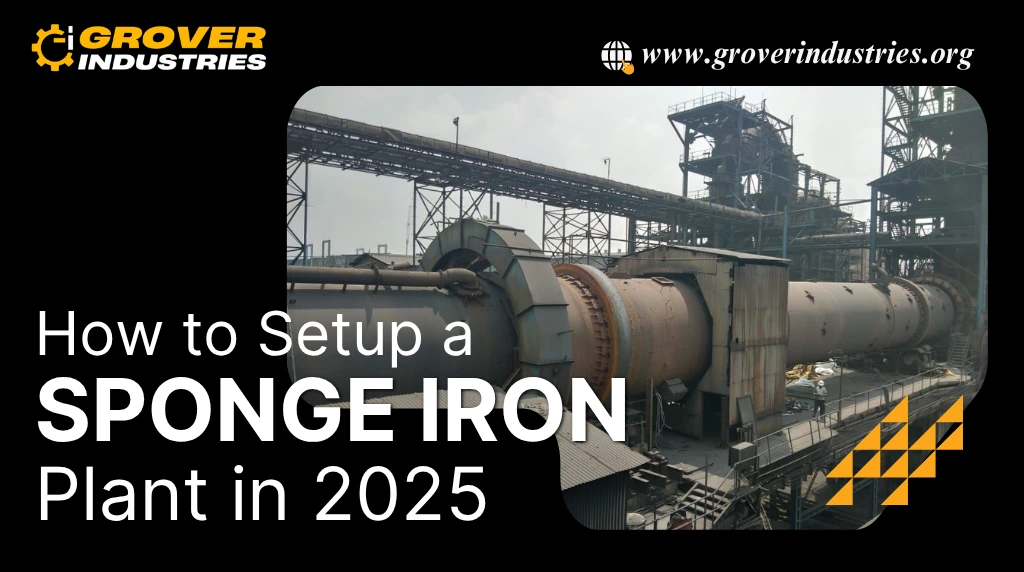
How to Set Up a Sponge Iron Plant in 2025
In the dynamic steel‐manufacturing landscape of India, the opportunity to set up a sponge iron (also called direct reduced iron – DRI) plant is stronger than ever. With urbanisation, infrastructure spending and steel demand on the rise, investing in such a facility can yield significant returns. As one of the trusted Sponge Iron Plant Manufacturers in Ghaziabad Uttar Pradesh, Grover Industries is positioned to help promoters and entrepreneurs navigate the complete setup from concept to commissioning. In this blog, we outline how you can set up a sponge iron plant in 2025 — with a focus on practical steps, site selection, machinery, raw materials, process flow, regulatory hurdles and market strategy.
Step 1: Market Analysis & Opportunity:
Before any major investment, Grover Industries recommends a full market assessment. According to industry reports, sponge iron is increasingly used as feedstock for steel, foundries and electric arc furnaces. Key drivers:
- Steel production growth in India and Asia.
- Preference for low-impurity feed materials in modern furnaces.
- Supply chain pressures prompting local production of sponge iron.
As one of the leading Sponge Iron Plant Manufacturers in India, Grover Industries can help conduct demand-supply checks for your region, estimate potential volume, and assess economics (capex, opex, break-even) based on benchmarks.
Step 2: Site Selection & Layout Planning:
Selecting the right location is critical. Grover Industries, specialising in setup services, emphasises the following site criteria for a sponge iron plant:
- Proximity to key raw materials: iron ore, coal (or natural gas if applicable), limestone and other fluxes.
- Good transport connectivity (rail/road) to supply and dispatch markets.
- Reliable utilities: electricity, water, gas/coal handling and waste management.
- Adequate land area and zoning permissions.
- Environmental & regulatory compliance: dust, emissions, effluent control.
Grover Industries will assist with plant layout optimisation: dividing zones for raw material storage, reduction kilns/shaft furnace, cooling, finishing, quality control labs, dispatch, and future expansion. Efficiency of material flow, safety and maintenance access are built-in.
Step 3: Technology & Machinery Selection:
As an experienced plant manufacturer, Grover Industries helps you select reliable, proven equipment tailored to capacity and feedstock. Key equipment/components include:
- Reduction furnace/shaft furnace or rotary kiln (depending on technology) for producing direct reduced iron.
- Cooling systems, conveyors, material handling systems.
- Dust collection units, pollution control equipment.
- Quality control laboratory and instrumentation to test iron content, impurities and ensure product spec.
Choosing the right technology ensures optimal yield, minimal waste, consistent product quality, and compliance with emission norms. Grover Industries, as one of the reliable Sponge Iron Plant Manufacturers in Ghaziabad Uttar Pradesh, offers turnkey solutions or modular plant builds.
Step 4: Raw Materials & Procurement:
The success of the plant hinges on raw material sourcing. Key inputs:
- Iron ore (hematite/magnetite): the main source of iron content.
- Reducing agent: coal, natural gas, or other carbon sources.
- Limestone/flux as needed.
- Additives, refractory materials, cooling water, electricity.
Grover Industries helps set up long-term contracts with reliable suppliers, map logistics to reduce transportation cost (which can significantly affect opex), and guide inventory strategy. Ensuring supply chain stability is especially important given global disruptions.
Step 5: Process Flow & Operations:
With the infrastructure, machinery and raw materials in place, the operational flow typically follows:
- Raw material receipt and storage (iron ore, coal, flux).
- Material preparation: screening, grinding, blending.
- Reduction process: in shaft furnace or rotary kiln under controlled conditions to produce sponge iron.
- Cooling, crushing/sizing (if required), provisional storage.
- Quality control lab testing for iron content, residuals.
- Packing or conveying to end-user (steel plant, foundry) or further processing.
- Waste handling: dust, off-gases, effluent.
Grover Industries supports plant design for smooth workflow, energy efficiency, and minimal handling losses.
Step 6: Financial Planning & Economics:
Your financial model must cover capital expenditure (CapEx) and operating expenditure (OpEx). Industry sources indicate that machinery costs dominate CapEx, while raw material costs dominate OpEx. Grover Industries assists with:
- Estimating land & site development costs, building, civil works.
- Machinery cost estimation.
- Utility cost: power, steam, water, fuel.
- Operating cost: labor, maintenance, raw material, logistics.
- Revenue projections: based on sponge iron production, market price.
- Break-even, pay-back period, return on investment (ROI) analysis.
- Sensitivity analysis for raw material price fluctuation, yield variation, etc.
Step 7: Regulatory, Environmental & Safety Compliance:
Setting up an industrial plant in 2025 requires full compliance. Key areas:
- Environmental clearance: air emissions, dust, effluents.
- Health & safety protocols for high-temperature operations.
- Labour regulations, welfare provisions.
- Fire prevention, gas leak control, dust explosion prevention (noted in reduction processes).
- Quality standards for output sponge iron, material handling standards.
Grover Industries ensures your plant design includes pollution control units, appropriate zoning reviews, and assistance with documentation to regulatory bodies.
Step 8: Commissioning, Production Ramp-Up & Market Linkages:
After installation, the plant must be commissioned and ramped to stable production. Grover Industries helps:
- Conduct trial runs, equipment testing, adjustments.
- Staff training (operators, maintenance, quality control).
- Establishing supply chain flows (raw-material in, product out).
- Establishing customer linkages: as one of the trusted Sponge Iron Plant Manufacturers in India, Grover Industries can assist in connecting with steel plants, foundries or end-users.
- Continuous monitoring of yield, quality, downtime, and refining operations.
Why Choose Grover Industries?:
As one of the leading Sponge Iron Plant Manufacturers in Ghaziabad Uttar Pradesh, Grover Industries brings:
- Local presence in Ghaziabad – facilitating proximity, faster service, easier coordination.
- End-to-end support: from feasibility and design to commissioning and after‐sales.
- Expertise in India’s context: raw material sourcing, regulatory nuances, labour markets.
- Turnkey solutions: enabling you to focus on operations and market, not just construction.
- Scalable designs: plant layouts that anticipate capacity growth, future technology upgrades.
If you’re considering setting up a sponge iron plant in India in 2025, partnering with a proven manufacturer like Grover Industries offers a strong foundation.
Conclusion:
Setting up a sponge iron plant in 2025 is a highly promising venture, given the favourable demand scenario for steel and related feedstocks in India. However, success requires meticulous planning — from site selection and technology to raw materials, regulatory compliance and market linkage. With Grover Industries — a trusted name among Sponge Iron Plant Manufacturers in Ghaziabad Uttar Pradesh and across India — you gain not just equipment, but full project support and local expertise. If you are ready to explore this investment, Grover Industries is equipped to guide you end-to-end and help you move from concept to commissioning with confidence.
FAQs:
1. What is the minimum land area required for a sponge iron plant?
The required land depends on plant capacity, layout, storage requirements and future expansion. Typical project‐profile sources show land and site development as major cost components. Grover Industries will help assess your capacity and propose optimal land.
2. Which raw materials are critical and how do I secure them?
Iron ore, reducing agent (coal or natural gas) and flux (limestone etc) are critical. Sourcing nearby suppliers, negotiating long‐term contracts and reducing transport cost are essential. Grover Industries can help map suppliers, logistics and inventory strategy.
3. What is the typical pay-back period for a sponge iron plant?
Pay-back period varies widely depending on plant size, technology, raw material cost, product price and efficiency. Project profiles show detailed financials including pay-back and IRR. Grover Industries will help build a tailored financial model for your project.
4. What environmental and safety compliance is required?
You must comply with air emissions, dust control, effluent treatment, industrial safety for high‐temperature and carbon‐reduction processes. Grover Industries ensures the plant layout, equipment and operations meet regulatory and safety standards.
5. Can the plant be expanded later?
Yes — a good layout anticipates future capacity expansion, additional kilns or furnaces, storage enlargement. As one of the reliable Sponge Iron Plant Manufacturers in India, Grover Industries designs plants with scalability in mind.
6. How important is the product quality and market linkage?
Very important. High iron‐content, low impurity sponge iron commands better acceptance by steel plants and foundries. Market linkage ensures you have off-take agreements and minimal inventory risk. Grover Industries supports both quality control setup and market connections.