

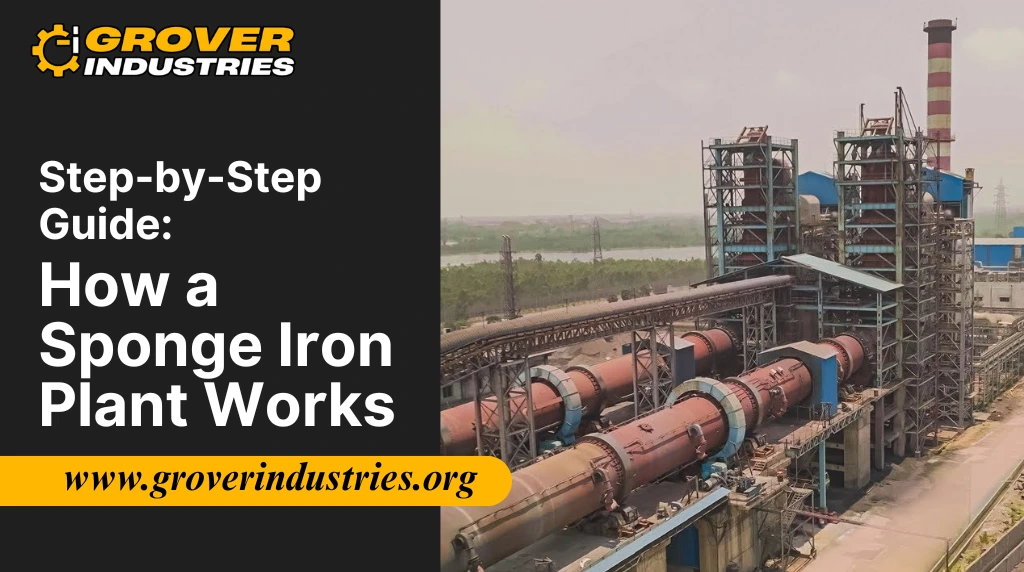
Step-by-Step Guide: How a Sponge Iron Plant Works
The steel industry forms the backbone of modern infrastructure, and sponge iron plays a vital role in this ecosystem. Also known as Direct Reduced Iron (DRI), sponge iron is a key raw material used in steelmaking, especially in electric arc and induction furnaces. Understanding how a sponge iron plant works is essential for manufacturers, plant operators, and investors looking to optimize production and efficiency.
Grover Industries, based in Ghaziabad, Uttar Pradesh, India, is a trusted Sponge Iron Plant Manufacturer and Supplier in Ghaziabad Uttar Pradesh India, delivering reliable and efficient plant solutions tailored to the needs of the iron and steel industry. In this guide, we explain the step-by-step working process of a sponge iron plant in a clear and practical manner.
What is a Sponge Iron Plant?:
A sponge iron plant is an industrial facility where iron ore is reduced directly to metallic iron using a reducing gas or solid carbon (coal) without melting the ore. This process removes oxygen from iron ore, resulting in a porous, sponge-like product—hence the name sponge irons.
Compared to traditional blast furnace methods, sponge iron production is more energy-efficient, cost-effective, and suitable for smaller steel plants.
Step-by-Step Working Process of a Sponge Iron Plant:
Step 1: Raw Material Preparation:
- Iron Ore: Usually in the form of lumps or pellets with high iron content.
- Coal: Acts as both fuel and reducing agent.
- Dolomite or Limestone: Used as a flux to control sulfur and maintain quality.
At this stage, raw materials are screened and sized to ensure uniformity. Proper preparation is critical for smooth kiln operation and consistent output quality.
Step 2: Feeding the Rotary Kiln:
Once prepared, the raw materials are fed into a rotary kiln, which is the heart of the sponge iron plant. The kiln is a long, cylindrical, refractory-lined structure installed at a slight incline and rotates slowly.
The materials are fed from the feed end, while coal injection and air supply systems regulate the internal temperature and chemical reactions inside the kiln.
Step 3: Reduction Process inside the Kiln:
As the kiln rotates, materials gradually move forward while being exposed to temperatures ranging from 800°C to 1050°C. This is where the actual reduction takes place.
- Coal releases carbon monoxide (CO).
- CO reacts with iron oxide in the ore.
- Oxygen is removed, leaving behind metallic iron.
This solid-state reduction process converts iron ore into sponge iron without melting it, preserving energy and reducing emissions.
Step 4: Temperature Control and Process Monitoring:
Maintaining the correct temperature profile inside the kiln is crucial. Advanced control systems continuously monitor:
- Kiln temperature
- Pressure
- Feed rate
- Coa l injection levels
As a leading Sponge Iron Plant Manufacturer and Supplier in Uttar Pradesh India, Grover Industries designs plants with robust control systems to ensure stable operation, high metallization, and minimal fuel consumption.
Step 5: Discharge of Sponge Iron:
After the reduction process is complete, the sponge iron is discharged from the kiln at the outlet end. At this stage, the material is still hot and must be cooled safely before handling. The discharge typically includes:
- Sponge iron
- Char (unburnt coal)
- Ash
Step 6: Cooling and Separation:
The hot material is transferred to a cooling drum or rotary cooler, where it is cooled using ambient air or water sprays. Cooling prevents oxidation and ensures safe downstream handling. Once cooled, magnetic separators are used to:
- Separate sponge iron from char and ash
- Improve product purity
- Recover usable by-products
Step 7: Product Handling and Storage:
The finished sponge iron is then conveyed to storage bins or silos. From here, it can be:
- Used directly in steelmaking
- Transported to induction or electric arc furnace units
- Stored for future use
Efficient material handling systems designed by Grover Industries ensure minimal loss, reduced dust generation, and smooth plant operation.
Key Advantages of Sponge Iron Plants:
Sponge iron plants offer several benefits to steel manufacturers:
- Lower capital investment compared to blast furnaces
- Reduced energy consumption
- Flexibility in plant capacity
- Use of non-coking coal
- Environment-friendly operation with proper pollution control systems
These advantages make sponge iron plants an ideal choice for growing steel industries across India.
Conclusion:
Grover Industries, located in Ghaziabad, Uttar Pradesh, India, has earned a strong reputation as a reliable Sponge Iron Plant Manufacturer and Supplier in Ghaziabad. With decades of engineering expertise, the company delivers:
- Customized sponge iron plant solutions
- High-quality rotary kilns and auxiliary equipment
- Efficient material handling systems
- Reliable after-sales support and technical guidance
Their focus on durability, efficiency, and performance makes them a preferred partner for sponge iron plant projects across the country.
FAQs:
1. What is the main purpose of a sponge iron plant?
The primary purpose of a sponge iron plant is to produce direct reduced iron (DRI), which is used as a raw material in steel manufacturing.
2. What raw materials are used in a sponge iron plant?
The main raw materials include iron ore, coal, and fluxes like dolomite or limestone.
3. Why is a rotary kiln used in sponge iron plants?
A rotary kiln allows controlled heating, uniform material movement, and efficient reduction of iron ore in a solid state.
4. Is sponge iron production environmentally friendly?
Yes, when equipped with proper pollution control systems, sponge iron plants are more energy-efficient and eco-friendly compared to traditional blast furnace methods.
5. How does Grover Industries ensure plant efficiency?
Grover Industries designs sponge iron plants with optimized kiln systems, advanced control mechanisms, and high-quality components to ensure consistent performance and reduced downtime.
6. Where is Grover Industries located?
Grover Industries is based in Ghaziabad, Uttar Pradesh, India, and serves clients across India as a trusted sponge iron plant manufacturer and supplier.