

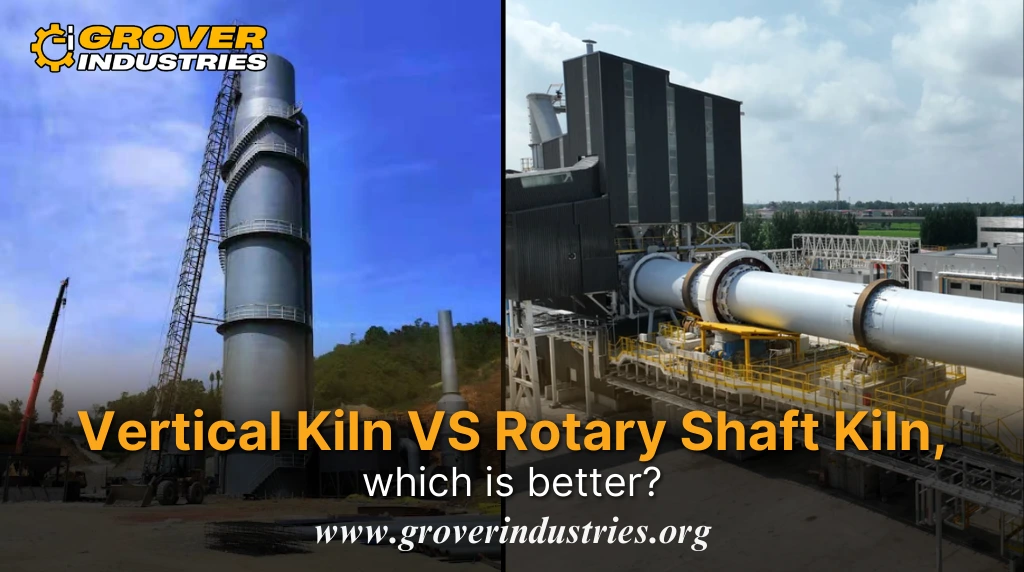
Vertical Kiln VS Rotary Shaft Kiln, which is better?
When you are in the business of manufacturing — whether as Sponge Iron Plant Manufacturers in Ghaziabad Uttar Pradesh India or Sugar & Paper Mill Manufacturers in Uttar Pradesh India, the choice of kiln can make a huge difference in efficiency, cost, and output quality. At Grover Industries, we believe in offering honest, practical guidance: the decision between a Vertical Shaft Kiln (VSK) and a Rotary Kiln should be made based on your plant size, production volume, investment capacity and long-term plans. Let’s dive into the comparison.
How do these kilns work — the basics:
Vertical Shaft Kiln (VSK):
A vertical shaft kiln is a static, upright structure. Raw material is fed from the top and descends downward by gravity through various temperature zones, while hot gases or combustion air rises from the bottom. This counter-current flow of material and gases provides effective heat transfer.
Because the kiln does not rotate and has fewer moving parts, the design is simpler. It is often used for small-to-medium scale calcination, lime production, or cement operations when the output requirements are modest.
Rotary Shaft Kiln:
A rotary kiln — a long, slightly inclined cylindrical vessel which rotates slowly — is widely used for continuous large-scale production. Raw material is introduced at the higher end; through rotation, the material moves gradually toward the lower end while being subjected to high temperatures. The rotation ensures uniform heating and mixing, enabling controlled chemical reactions over the length of the kiln.
The rotary kiln is often equipped for automation; modern units allow precise control of temperature, rotation speed, fuel use, exhaust gas flow, and more — ideal for large industrial operations.
Pros & Cons — What each kiln offers (and where they fall short):
Vertical Shaft Kiln — Strengths and Limitations:
Advantages:
- Lower capital investment and simpler infrastructure: Because of its simpler design and static structure, initial costs (foundation, civil works, mechanical parts) are much lower compared to a rotary kiln.
- Compact footprint, space efficiency: VSKs occupy less ground space, making them suitable for plants with limited land or compact layouts.
- Lower operating and maintenance complexity: With fewer moving parts and simpler mechanical systems, maintenance is easier, breakdowns are fewer, and labor requirements are lower.
- Good for small to medium scale production: If your demand or output is modest, or you are a smaller enterprise, VSK makes economic sense.
Disadvantages:
- Limited production capacity: VSKs cannot handle very large volumes; as demand grows, you may find them inadequate.
- Product quality and consistency can suffer: Because material movement and heat distribution are less uniform than in a rotating kiln, there may be variability in output quality (e.g. uneven calcination).
- Lower automation, more manual involvement: Operations tend to be more manual, with less scope for automatic control or process optimization.
- Less suitable for stringent environmental or quality standards: As modern industrial standards (in cement, lime, or material calcination) demand consistent output and efficient emission control, VSK may struggle to meet those requirements.
In short: vertical kilns are cost-effective, simple and well-suited for small/medium plants, but may fall short when scale, uniformity, or high-quality output is a priority.
Rotary Shaft Kiln — Strengths and Limitations:
Advantages:
- High production capacity and continuous operation: Rotary kilns are ideal for large-scale manufacturing. They support high throughput, continuous operations and are the backbone of modern large-scale cement, lime, or other calcination-based plants.
- Uniform heating and consistent product quality: The rotating motion ensures raw materials are evenly heated and mixed, leading to stable, high-quality output.
- Better automation and control: Rotary kilns integrate well with automated feed systems, temperature control, waste-heat recovery, and emission-control technologies.
- Flexibility in raw materials and fuels: They can handle a wide range of raw material particle sizes and different fuel types (coal, gas, petcoke, etc.), making them versatile for different applications beyond cement — e.g. in refractory, magnesia, lime, or metallurgical production.
Disadvantages:
- High initial capital cost and infrastructure demands: The kiln itself, plus required supporting structures, civil work, dust/gas handling, and automation, demands significant investment and space.
- Complex maintenance and skilled operation required: Because of moving parts (rotating shell, mechanical drive, seals, refractory lining), maintenance is more demanding and often requires trained personnel.
- Higher operating and fuel costs in some cases: Although modern rotary kilns often aim for energy efficiency, fuel consumption and energy loss (if waste heat is not optimally recovered) can still be relatively high compared to simpler kilns.
In essence: rotary kilns are the go-to choice when you need scale, consistency, automation, and long-term reliability — but they demand high capital and more complex operation.
What works best for Grover Industries?:
At Grover Industries, we believe the choice depends on your business scale and future vision:
- If you are a small or medium-scale enterprise (for example, a modest Sponge Iron plant, or a smaller Sugar & Paper mill operation), with limited budget, land, or demand — a Vertical Shaft Kiln could be a smart and economical start. Its lower capital requirements, simpler maintenance, and compact footprint make it ideal for startups or industries with moderate output.
- However, if you plan large-scale, continuous production, want consistent, high-quality output, and foresee scaling up — a Rotary Kiln is likely the better long-term investment. Especially for sectors requiring uniform material quality (e.g. high-grade lime, refractory materials, or heavy-duty industrial calcination), the reliability and control offered by rotary kilns become critical.
Moreover — if you are positioning Grover Industries as a major name among Sponge Iron Plant Manufacturers in Ghaziabad Uttar Pradesh India or among Sugar & Paper Mill Manufacturers in Uttar Pradesh India — and expect growth, adopting rotary kilns gives scalability and a future-proof infrastructure.
That said, for new plants or cost-sensitive setups, starting with VSK may offer a lower-risk entry point, with the possibility to upgrade later if demand increases.
Suggested Approach: Hybrid/Phased Strategy:
Many industries begin with a Vertical Shaft Kiln to manage investment and operational costs. As production and demand grow, they add or switch to Rotary Kiln units. For Grover Industries, this hybrid or phased-growth strategy can provide flexibility — enabling you to balance capital expenditure and production needs, while gradually scaling operations as demand rises.
This way, you minimize risk upfront, but retain the option to expand and upgrade when business volume justifies the investment.
Conclusion:
There is no one-size-fits-all answer. For small-to-medium scale operations or first-time manufacturing plants, a Vertical Shaft Kiln makes sense — it is economical, simpler, and easier to manage.
For large-scale, high-output, continuous manufacturing, or when consistent quality and automation are priorities — a Rotary Shaft Kiln is clearly the better long-term choice.
At Grover Industries, we evaluate each client’s production goals, budget, and capacity, and recommend the kiln type accordingly — because the best kiln depends entirely on your specific industrial requirements and future growth plans.
FAQs:
1. What kinds of industries benefit from Vertical Shaft Kilns (VSK)?
VSKs are ideal for small-to-medium scale lime production, small cement plants, or industries with limited land/investment. They suit operations where output demand is modest and cost minimization matters.
2. Can Vertical Shaft Kiln produce high-quality products like rotary kilns?
While VSK can deliver acceptable quality for smaller or moderate productions, the output may not be as uniform or consistent as that from a rotary kiln — especially for applications needing strict quality standards.
3. For a growing industry (e.g. a new sponge iron plant), is starting with VSK advisable?
Yes — starting with VSK can reduce initial costs and risks. As output and demand grow, Grover Industries can help scale up, potentially shifting to rotary kiln or expanding capacity.
4. What are the maintenance differences between the two kiln types?
VSKs have simpler maintenance due to fewer moving parts — less frequent breakdowns, lower labor requirements, and lower maintenance cost. Rotary kilns, due to rotating shells, mechanical drive systems, refractory linings, and seals, require more skilled maintenance and higher operational attention.
5. Does a rotary kiln offer better automation and environmental compliance?
Yes, rotary kilns are better suited for automation — fine control of temperature, feed rate, exhaust, and waste-heat recovery. They also integrate more easily with modern emission control systems, making them more compliant with stricter environmental standards.
6. How should a manufacturer decide between VSK and Rotary Kiln?
Decide based on: your production scale, budget/investment capacity, land/space availability, demand forecast, quality requirements, and long-term growth plans. For small/medium scale and cost-sensitive setups — VSK; for large-scale, high-quality output, and scalable growth — Rotary Kiln.